New Patients: Finding the right clinic shouldn't take forever! Click Here

Axion microneedling explained by Dr Yiannis. Evidence-based skin regeneration with needling, infusion, and LED at the Anti Wrinkle Clinic London
Innovation in aesthetic medicine should never be about doing more to the skin. It should be about doing better – with greater precision, greater understanding, and greater respect for biology.
Over the past decade, we have moved away from aggressive skin resurfacing and toward regenerative stimulation. The focus is no longer on removing layers of skin, but on encouraging the skin to repair itself in a controlled, measured way. Devices are now judged not only by what they can do, but by how intelligently they bring together different mechanisms of repair.
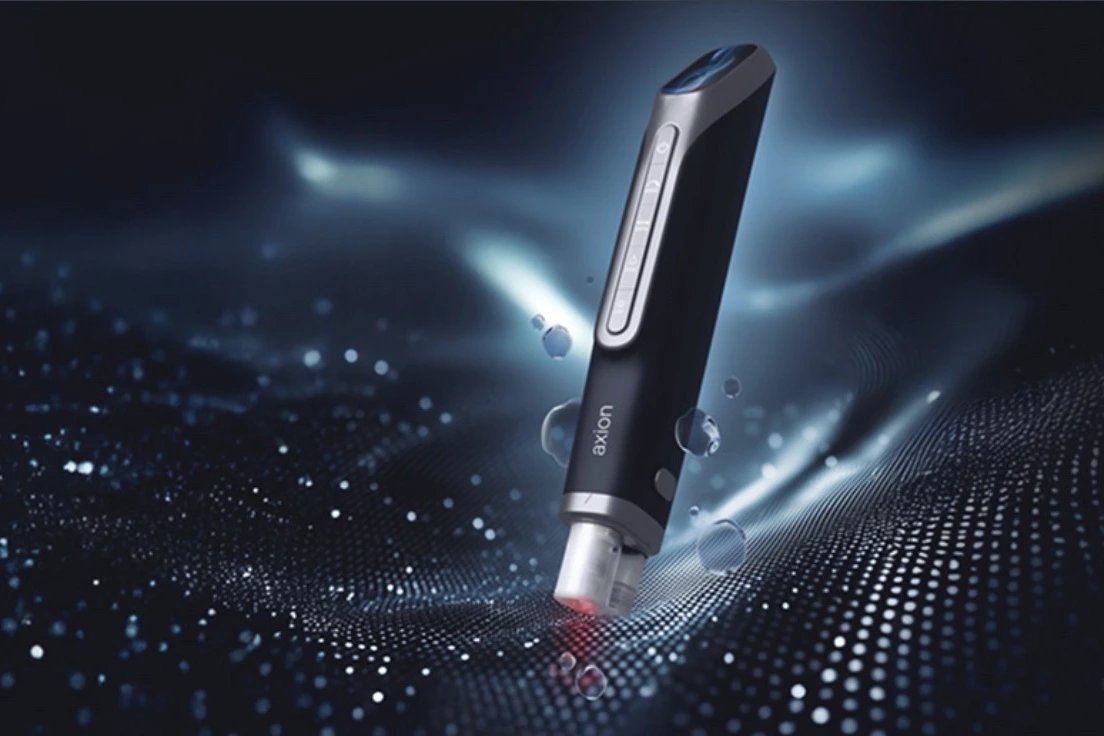
The Axion system by Mesoestetic is a great example of this evolution.
Rather than treating Microneedling, mesotherapy infusion, and LED phototherapy as separate steps, Axion integrates them into one synchronised treatment. Mechanical stimulation, biochemical support, and photobiological modulation occur simultaneously, in a single pass of the device.
To understand why this integration matters, it is important to first understand the individual mechanisms that underpin regenerative skin treatment.
Microneedling, also known as collagen induction therapy, involves creating thousands of very small, controlled microchannels in the skin using fine needles [1]. These are not random injuries. They are deliberate, precise signals that tell the skin to repair itself [1].
When the skin senses this controlled stimulation, it activates a series of repair mechanisms. The key players in this process are fibroblasts, which are the cells responsible for producing collagen and elastin. Collagen gives the skin structure and firmness, while elastin provides elasticity and resilience.
Histological studies (the study of the microscopic structure of tissues) have shown that repeated Microneedling sessions can increase collagen and elastin production in the dermis, the deeper layer of the skin responsible for strength and support [3]. In simple terms, this means the skin is encouraged to rebuild itself from within, rather than simply appearing smoother on the surface.
I want to highlight that Microneedling does not remove layers of skin like ablative laser treatments or some medical grade chemical peels. Instead, it stimulates regeneration while preserving the outer protective barrier. Studies have shown that Microneedling can improve acne scarring with a favourable safety profile and fewer complications compared with more aggressive resurfacing procedures [4].
When Microneedling first became popular in the late 2000s, visible pinpoint bleeding was often seen as a marker of success. The thinking at the time was straightforward – that more injury meant more collagen. We now know that this is not necessary for most indications.
Current evidence suggests that, for most anti-ageing indications, mild redness (erythema) is enough to trigger collagen production while reducing downtime and inflammation [3]. Deeper needling still has an important role in the treatment of atrophic acne scars, surgical scars, and stretch marks. However, modern protocols favour controlled, targeted stimulation over excessive injury.
Mechanical stimulation alone can initiate regeneration. But stimulation is only one part of the repair cascade.
Beyond collagen stimulation, Microneedling has another important function – it temporarily increases the permeability of the skin barrier. The outermost layer of the skin – the stratum corneum – is highly effective at preventing penetration of external substances. By creating microchannels, microneedling temporarily bypasses this barrier [5,6].
Research in transdermal delivery has demonstrated that microneedles can significantly enhance absorption of certain active compounds [6]. This principle has been explored not only in cosmetic dermatology, but also in pharmaceutical applications.
In traditional protocols, topical sub-dermal solutions are applied after needling. However, the window for enhanced absorption is limited because microchannels begin to close soon after they are created.
Microneedling-enhanced delivery is supported by research demonstrating increased transdermal absorption through microchannels [5]. While further comparative studies would help quantify the difference between sequential and simultaneous application, the biological rationale for targeted infusion remains strong.
Yet even with enhanced delivery, regeneration does not occur in isolation. Cellular energy and inflammatory balance also influence outcomes.
Red light therapy has been studied extensively in wound healing and tissue repair. Red light interacts with structures within the mitochondria, the energy-producing components of our cells. This interaction can increase adenosine triphosphate (ATP) production, which supports cellular metabolism and repair [7].
When LED therapy is delivered during or immediately after Microneedling, the aim is not to increase trauma, but to optimise recovery. Photobiomodulation may help modulate the inflammatory response and support the transition from inflammation to tissue repair [9].
Each of these mechanisms – mechanical stimulation, biochemical support, and photobiological modulation – has scientific validity on its own.
The question is not whether they work individually.
The question is what happens when they are synchronised.
Traditional Microneedling typically follows a sequence. First, the skin is needled. Then, a topical solution may be applied. Finally, LED therapy may be performed separately.
Axion approaches this differently.
As mentioned, microchannels begin to close soon after they are created. By delivering active ingredients at the moment of channel formation, distribution and absorption may be improved. At the same time, red LED light supports cellular energy production and healing from the earliest stage of stimulation [7].
The science behind Microneedling, transdermal delivery, and photobiomodulation is well established. What Axion does is integrate them into a cohesive, streamlined platform.
One of the most clinically meaningful features of the Axion platform is its cartridge system.
Not all skin concerns require the same depth or intensity. The skin under the eyes is very different from and far more delicate than the skin on the cheeks. Acne scars require a different approach from mild textural changes. A device that offers only one level of stimulation cannot address this variation optimally.
This allows for more focused dermal stimulation. It is particularly suited to structural concerns such as acne scars, deeper lines, and areas where collagen remodelling is the primary goal.
This provides broader coverage with medium-intensity stimulation. It is often used for general rejuvenation, pore refinement, and overall improvement in skin texture.
This works at a very superficial level, enhancing product delivery and improving delicate areas such as the under-eye region without deep dermal trauma.
This flexibility allows the treatment to be tailored not only to the patient, but also to different areas of the same face.
For example, deeper stimulation can be applied to acne-scarred cheeks, moderate stimulation across the mid-face for rejuvenation, and superficial nano-needling under the eyes – all within one structured protocol using the same Axion system.
This level of adaptability reminds us that skin is not uniform, and so treatment should not be either.
One of the most common areas of confusion for patients is the difference between Microneedling and Nanoneedling. The terms are sometimes used interchangeably, but they are not the same – and understanding the distinction helps explain why a system like Axion, with its interchangeable heads, is clinically meaningful.
The key difference lies in depth.
Nanoneedling works at a very superficial level, typically around 0.1–0.3 mm. At this depth, the needles primarily interact with the upper layers of the skin. The goal is not deep collagen stimulation, but enhanced product delivery and improvement in surface texture.
Microneedling, in contrast, works at greater depths, usually between 0.5 mm and 2.5 mm depending on the indication. At these depths, the needles reach the dermis, where collagen and elastin are produced. This is where structural remodelling occurs.
It’s important to note that deeper is not always better. Just like with skincare, more product doesn’t mean faster or better results.
Modern regenerative protocols emphasise selecting the appropriate depth for the specific concern and anatomical area. The skin under the eyes, for example, is thinner and more delicate than the cheeks. Treating both areas at the same depth would not reflect an anatomically informed approach.
This is where Axion’s interchangeable cartridge system becomes particularly valuable. By switching between nano-pin, medium-intensity, and deeper-penetrating heads, treatment can be tailored precisely.
All can be performed within the same session, and all using the same integrated platform.
When it comes to regeneration in medical aesthetics, precision is everything. Understanding when to stimulate deeply and when to work superficially allows us to support the skin intelligently rather than uniformly. Depth selection is not simply a technical setting – it is a clinical decision.
An integrated Microneedling platform such as Axion may be suitable for patients seeking improvement in:
The under-eye area is particularly interesting. Many of my patients assume that volume loss is always the primary issue. In reality, thinning skin and reduced collagen density often contribute significantly to under-eye ageing.
Using the nano-pin cartridge for superficial stimulation, combined with targeted infusion and LED support, allows improvement in skin integrity without adding volume. For some patients, improving skin quality is often more appropriate than immediately turning to dermal fillers.
As always, a thorough assessment is essential. During your consultation – or in your initial Face-to-Face Hour – I will carefully review your medical history and lifestyle. Certain factors, such as active infections, uncontrolled inflammatory skin conditions, specific medical circumstances, or pregnancy, may require caution or postponement to ensure your safety and the best possible outcome.
Microneedling has a well-established safety profile when performed by trained clinicians using appropriate protocols.
Studies have demonstrated increased dermal collagen and elastin after multiple sessions, with favourable safety outcomes when protocols are followed correctly [3]. Most patients experience mild redness for 24 to 48 hours, and downtime is typically minimal compared with more aggressive resurfacing procedures.
Interestingly, the name Axion is derived from the Greek word ἄξιον (aksion), meaning worthy or deserving. Being Greek myself, I find that symbolism fitting.
I believe that in aesthetic medicine, a treatment must be worthy of evidence, worthy of trust, and worthy of the skin we are privileged to treat.
The Axion platform does not reinvent Microneedling. It refines it. It does not replace established regenerative principles. It integrates them – mechanical stimulation, biochemical support, and photobiological modulation – into one cohesive system.
For me, innovation is meaningful only when it serves patients. Integration, personalisation, and respect for biology represent the direction regenerative aesthetics is moving toward.
If a treatment is to be worthy, it must first be coherent.
Axion’s strength lies not in novelty alone, but in how thoughtfully it brings together mechanisms we already understand – and applies them with precision.
[1] Aust MC, Fernandes D, Kolokythas P, Kaplan HM, Vogt PM. Percutaneous collagen induction therapy: An alternative treatment for scars, wrinkles, and skin laxity. Plast Reconstr Surg. 2008.
[2] Fabbrocini G, De Vita V, Pastore F, et al. Combined use of skin needling and platelet-rich plasma in acne scarring treatment. Dermatol Surg. 2011.
[3] El-Domyati M, Barakat M, Awad S, Medhat W, El-Fakahany H, Farag H. Multiple microneedling sessions increase dermal collagen and elastin in human skin. J Clin Aesthet Dermatol. 2015.
[4] Majid I. Microneedling therapy in atrophic acne scars: An objective assessment. J Cutan Aesthet Surg. 2009.
[5] Ita K. Transdermal delivery of drugs with microneedles—Potential and challenges. Pharmaceutics. 2015.
[6] Kim YC, Park JH, Prausnitz MR. Microneedles for drug and vaccine delivery. Adv Drug Deliv Rev. 2012.
[7] Avci P, Gupta A, Sadasivam M, et al. Low-level laser (light) therapy in skin: Stimulating, healing, restoring. Semin Cutan Med Surg. 2013.
[8] Barolet D, Boucher A. Prophylactic low-level light therapy for skin rejuvenation. J Cosmet Laser Ther. 2010.
[9] Dai T, Huang YY, Hamblin MR. Photobiomodulation for wound healing and tissue repair. Expert Rev Med Devices. 2015.
Do I need a consultation before treatment?
Yes – every treatment at the Anti Wrinkle Clinic starts with a consultation. This is an essential step to ensure Microneedling is both suitable and safe for you. During your consultation, I’ll take the time to understand your goals, review your medical history, and discuss what’s best for your skin.
Please note that payment doesn’t automatically guarantee a treatment. If anything comes up during your consultation that makes a procedure unsafe or unsuitable, I will explain why and recommend alternative options.
Who performs the Anti-Wrinkle Injections treatment?
All treatments are personally performed by Dr Yiannis (that’s me!), a fully qualified medical aesthetic practitioner with over 20 years of experience. My academic and clinical background includes:
Over the past 20 years, I have also completed extensive postgraduate training in facial aesthetics, participating in numerous advanced, hands-on training modules both in the UK and across Europe. This includes training delivered by internationally recognised experts in medical aesthetics as well as by the pharmaceutical and medical device companies whose products I use in clinic, ensuring my techniques are up to date, evidence-based, and aligned with the highest safety standards.
Everything that happens at the Anti Wrinkle Clinic, I personally carry out – ensuring consistency, safety, and care from start to finish.
Are your treatments regulated?
Yes – all injectable treatments at the Anti Wrinkle Clinic are prescription-only and fully regulated under UK medical guidelines. Treatments are prescribed and administered exclusively by Dr Yiannis, following an in-person consultation to confirm suitability.
Rest assured, we follow strict clinical and hygiene protocols, source products only from licensed UK pharmacies.
Does microneedling hurt? Will I need numbing cream?
Most of my patients describe microneedling as uncomfortable rather than painful. The sensation depends on the depth and the area being treated. For deeper treatments, especially for acne scarring, I use a topical anaesthetic to keep you comfortable.
At the Anti Wrinkle Clinic, treatments are always personalised to both the indication and your comfort level.
How many sessions are needed for visible results?
For general skin rejuvenation, many patients notice improved texture and radiance after one session, with more visible structural changes after three treatments. Collagen takes time to rebuild, so results continue to improve over several weeks.
For acne scarring or deeper concerns, a course of three to six sessions is usually recommended. I always explain to my patients that microneedling is regenerative, not a one-off quick fix.
What is the downtime after microneedling?
Downtime is typically minimal. Most patients experience redness similar to mild sunburn for 24 to 48 hours. Slight sensitivity or swelling can occur with deeper treatments.
In clinic, I follow controlled protocols that prioritise regeneration with minimal inflammation, so recovery is usually straightforward.
How many sessions will I need, and how are they spaced?
Microneedling is a regenerative treatment that works by stimulating collagen production over time. While many patients notice improved radiance and texture after just one session, structural changes require a course of treatments.
Sessions are typically spaced 4–6 weeks apart, depending on depth and your skin’s healing response. After completing a course, maintenance treatments every few months can help preserve collagen production and skin quality as natural ageing continues.
Remember, this is not a quick fix, but rather a long-term strategy for stronger, healthier skin!
What should I do before and after treatment?
Both preparation and aftercare are super important to optimise Microneedling results and minimise irritation.
Before treatment:
After treatment:
If you experience any unusual symptoms – be that pain, discomfort, itching, redness, then please contact the clinic immediately on +44 20 3598 7358
Is microneedling safe for the under-eye area?
Yes, when performed at the appropriate depth and with the right technique. The under-eye skin is delicate, so superficial nano-needling is often used to improve skin quality without deep trauma.
In many of my patients, under-eye ageing relates more to thinning skin than volume loss. Improving skin integrity in this area can be very effective when done carefully.
What is the difference between microneedling and nanoneedling?
The difference is depth. Microneedling works deeper in the skin to stimulate collagen and improve scars, lines, and laxity. Nanoneedling is more superficial and focuses on enhancing product absorption and improving surface texture.
When appropriate, I may combine both approaches within the same session to tailor treatment precisely.
Can microneedling be combined with skin boosters or mesotherapy?
Yes. Microneedling temporarily increases skin permeability, which can enhance the delivery of active ingredients such as hyaluronic acid, peptides, or polynucleotides.
With integrated systems like Axion, infusion occurs during the needling process itself. Combination treatments are always selected carefully based on your skin and long-term goals.
What is the difference between microneedling and Radiofrequency microneedling?
Both treatments stimulate collagen, but through different mechanisms.
Traditional microneedling uses controlled mechanical micro-injuries to trigger collagen production. It is excellent for improving texture, fine lines, acne scars, and pores, with minimal heat and lower risk of post-inflammatory pigmentation.
RF microneedling combines needles with controlled heat delivered into the dermis. The added thermal energy can enhance skin tightening and may be helpful for moderate laxity or deeper wrinkles. It’s important to know that RF treatments can involve more discomfort, higher cost, and greater pigmentation risk in certain skin types.
The right choice depends on your skin, your concerns, and your long-term strategy – which we will discuss during consultation.
Which areas can Microneedling treat, and how does it work?
Microneedling is highly adaptable. In clinic, I commonly treat areas such as the under-eyes, cheeks, forehead, jawline, and around the mouth. It can also be used on the body for concerns like stretch marks, scars, and even areas of hair thinning.
The treatment works by creating tiny, controlled microchannels in the skin. These stimulate your natural repair response, encouraging collagen and elastin production.
When combined with targeted sub-dermal solutions – including exosomes, Polynucleotides, hyaluronic acid, antioxidants, niacinamide, and NAD+ – we can tailor the treatment to address pigmentation, dehydration, fine lines, laxity, acne scarring, reduced elasticity, and hair thinning.
The key is selecting the right depth and the right solution for your specific concern.
What sub-dermal solutions can be applied with Axion Microneedling?
Axion allows the delivery of targeted professional Microneedling solutions selected according to skin concern, anatomical area, and treatment depth. These are selected following clinical assessment and tailored to your skin’s individual needs.
Sub-dermal solutions from the professional range include:
Exosome-based formulations are also available, including:
The selection depends on your skin condition, goals, and the depth of stimulation required. As always, no two treatment plans are identical.
Who should avoid Microneedling?
Microneedling isn’t suitable for everyone. You shouldn’t have treatment if you’re pregnant, breastfeeding, have an active skin infection, or have known allergies to any of the ingredients.
If you have certain medical conditions, are taking blood-thinning medication, or have recently had facial procedures or vaccinations, treatment may need to be delayed. Rest assured, all of this will be discussed in your consultation.
Learn more about our unique consultation process, your Face-to-face hour – a dedicated 60-minute, in-person appointment with Dr Yiannis.
Face-to-face hour